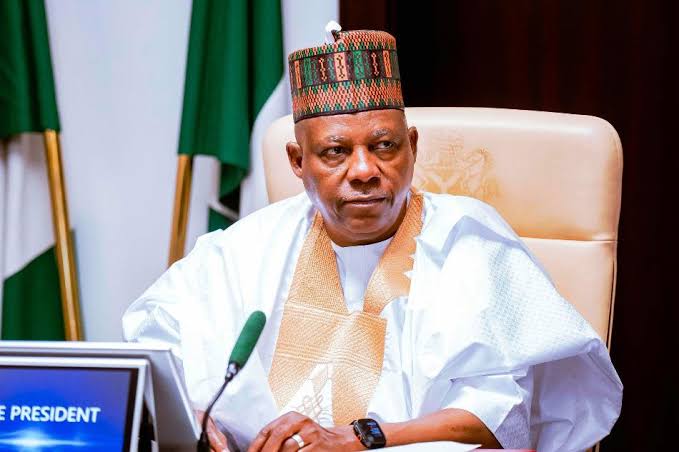
Vice President Kashim Shettima has said Nigeria and Ethiopia can feed Africa if both countries deepen cooperation in modern agriculture and large-scale food production.
Shettima spoke yesterday during a visit to wheat, banana and papaya farms in Ethiopia’s Oromia Regional State as part of the Nigeria-Ethiopia Nutrition Leadership Exchange.
He said food security was central to national sovereignty, warning that dependence on food imports could undermine a country’s independence.
“Food dependency compromises our sovereignty. So long as a nation is not independent in the area of food sovereignty, it remains a non-sovereign nation,” he said.
Shettima said Nigeria was determined to achieve food sovereignty through improved seeds, mechanisation and climate-smart agriculture.
He praised Ethiopia’s agricultural transformation, particularly its progress in wheat production, describing the country as a model for Nigeria and other African countries.
“Africa must learn to feed itself. Ethiopia is doing it, and Nigeria is on course to do the same. Ethiopia is a success story worthy of emulation,” he said.
According to Shettima, Ethiopia has moved from importing about $1 billion worth of wheat annually to producing enough for domestic needs and exporting to countries including Djibouti and Kenya.
He said Nigeria would seek to replicate aspects of Ethiopia’s agricultural model.
“We intend to embrace improved seeds, mechanisation, and climate-smart agriculture,” he said.
Shettima also announced that Nigeria would launch a massive tree-planting campaign from the next rainy season, with a target of planting 20 billion trees.
He said the programme would draw inspiration from Ethiopia’s Green Legacy Initiative and combine environmental restoration with job creation.
“We will embark on a massive tree planting campaign from the next rainy season. It requires a lot of planning, energy and drive, which Ethiopia was able to galvanise its population into doing. We intend to plant 20 billion trees,” he said.
The Vice President said the combined population of Nigeria and Ethiopia, estimated at more than 400 million, meant that agricultural progress in the two countries could have a wider impact across Africa.
“The success of Ethiopia will reverberate across the length and breadth of East and Southern Africa,” he said.
President of Oromia Regional State, Shimelis Abdisa, said Ethiopia’s agricultural transformation had been driven by deliberate investment in production capacity and support for farmers.
He said Ethiopia had also reduced its dependence on imported agricultural inputs.
“For bananas, we used to bring all tissue cultures from abroad. Now we have our own tissue culture centre,” Abdisa said.
He said Ethiopia had also defied scepticism over its ability to achieve wheat self-sufficiency.
“Everybody was campaigning that it is impossible to be self-sufficient. But our Prime Minister took a bold measure that Ethiopia can be self-sufficient in wheat,” he said.
Abdisa said production by smallholder farmers had helped the country replace about $1 billion in wheat imports.
“From smallholder farmers, we substituted 1 billion dollars of wheat import. Who is getting the subsidy? The nation,” he said.
He also outlined an ambitious expansion of Ethiopia’s poultry industry.
According to Abdisa, the country initially produced about 1 million chicks annually but has now reached 120 million annually, with hatcheries under construction expected to add another 160 million.
The long-term target, he said, is to reach three billion chicks annually to meet domestic demand and supply the wider African market.
“Our target is to go beyond to reach 3 billion chick capacity to cover our total market and also for the African market,” he said.
Abdisa said Ethiopia’s climate also gave it an advantage in poultry production by reducing energy costs associated with heating and cooling.
Regarding agricultural financing, he said the regional government provides farmers with pumps and inputs through a revolving fund, with beneficiaries required to repay.
“We don’t make our farmers dependent on us. We are not subsidising agriculture directly,” he said.
Abdisa also said Ethiopia earns about $3.1 billion annually from coffee, while the country has significant potential to expand banana production.
“For bananas, we can be the biggest producer because the environment is there, the water is there,” he said.
The Oromia regional government, he added, would collaborate with Nigerian conglomerate Dangote on fertiliser production for farmers in the region.